
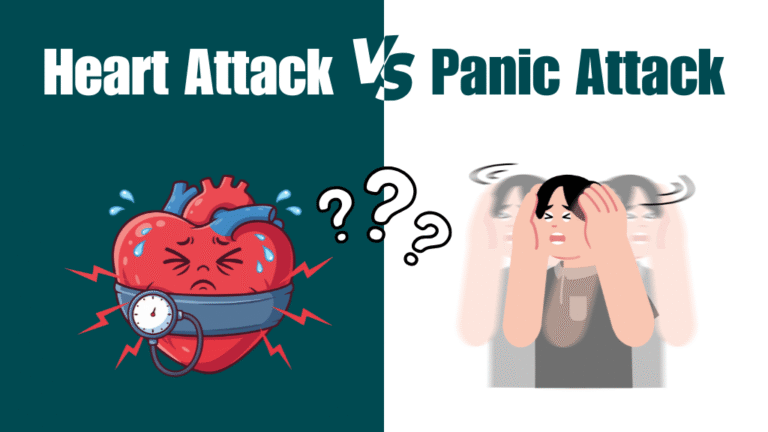
Heart Attack vs Panic Attack: How to Tell the Difference
How to know what your body is actually telling you - and what to do about it.
Heart attack and panic attack symptoms can feel remarkably similar. Chest tightness, a racing heart, shortness of breath, a wave of dread. In the moment, it can be genuinely hard to know which one you’re dealing with.
One of the most useful ways I’ve found to explain the difference comes down to a slightly odd image:
Does it feel like an elephant is sitting on your chest?
Weird, I know. But bear with me, as I’ll explain later.
The truth is, a heart attack and a panic attack can produce many of the same sensations. But they are very different in almost every other way, and learning to tell them apart can make a profound difference to how you respond in the moment as well as the steps you take after that.
Should you, or anyone you know, ever experience something that feels like a heart attack or panic attack, this guide should help decipher which one it is and what steps you can take next.
What is a panic attack?
A panic attack is an intense, sudden surge of fear or anxiety that triggers a cascade of physical symptoms, even when there is no real or immediate danger present.
During a panic attack, your brain’s alarm system activates your fight-or-flight response. Adrenaline floods your body, your heart rate increases, your breathing speeds up, and your muscles prepare to deal with a perceived threat. The reason why panic attacks are often so overwhelming and confusing is that there often isn’t an immediate or identifiable cause.
Common panic attack symptoms include:
- A racing or pounding heart (palpitations)
- Chest tightness or chest pain
- Shortness of breath or feeling like you can’t get enough air
- Dizziness, lightheadedness, or feeling faint
- Tingling or numbness in the hands, feet, or face
- Sweating or chills
- A feeling of unreality or being detached from yourself
- An overwhelming sense of doom or dread, a feeling that something terrible is about to happen
Panic attacks typically peak within 10 to 20 minutes and then begin to subside. They are not physically dangerous, even when they feel absolutely terrifying. They can happen anywhere: driving, at work, at home, even during sleep, and sometimes with no obvious trigger at all.
What is a heart attack?
A heart attack, medically known as a myocardial infarction, occurs when blood flow to part of the heart muscle becomes blocked, usually due to a clot or a significant narrowing of the arteries. Without blood and oxygen, the heart muscle begins to sustain damage.
Unlike a panic attack, a heart attack is a medical emergency that requires immediate treatment.
Common heart attack symptoms include:
- Chest pain, pressure, or a squeezing sensation, often described as a heavy weight on the chest
- Pain or discomfort that radiates to the arm (especially the left arm), jaw, neck, back, or stomach
- Shortness of breath, which may come on without exertion
- Nausea, vomiting, or a feeling of indigestion
- Cold sweats
- Sudden fatigue or weakness
- Feeling of impending doom
Symptoms can come on suddenly or build gradually over minutes or hours. In some cases, particularly in women, the symptoms may be more subtle and less “textbook” than expected.
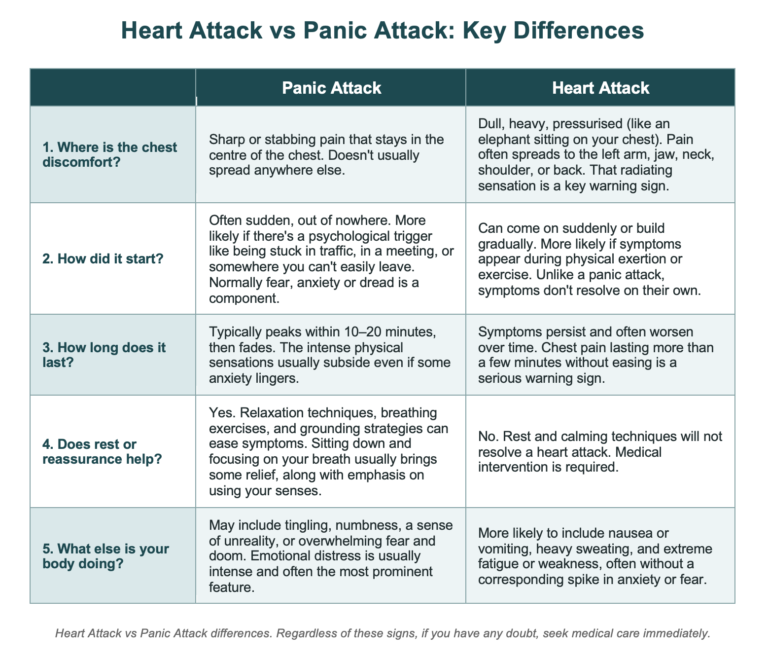
Heart attack vs panic attack: the key differences
Because there is significant overlap in how these two experiences feel, it can be genuinely hard to distinguish them, especially in the moment. Here are the most important differences to be aware of:
Can a panic attack feel like a heart attack?
Yes. And this is one of the most important things to understand.
Because a panic attack activates the same fight-or-flight system that produces intense physical reactions, it is entirely possible for a panic attack to feel almost identical to a heart attack. The chest tightness, racing heart, shortness of breath, and sense of doom can be indistinguishable in the moment.
In fact, many people experiencing a panic attack for the first time end up in the emergency room speaking to a doctor, genuinely convinced they are having a cardiac episode. This is not an overreaction; it is a completely understandable response to sensations that feel life-threatening.
The important distinction is this: if it is a panic attack, the sensations are not physically dangerous, even though they feel that way. Your body is doing exactly what it was designed to do: it has activated your natural alarm system in response to a threat. The problem is that threat is not necessarily real, or it is distorted in some way.
If you’re unsure, always err on the side of caution and seek medical help.
What to do if you think you’ve had a panic attack
Once you have ruled out a medical emergency or have been checked by a doctor, the most effective thing you can do to handle a panic attack is to stop fighting it.
This may feel counterintuitive. Every instinct in your body will urge you to resist, escape, reject or suppress what you’re experiencing. But that resistance is often what makes the panic attack get worse. The more you fight a panic attack, the longer it tends to last.
If you want to handle panic attacks better, try this:
- Allow the sensations to be present without trying to push them away.
- Remind yourself: “The feelings are temporary, they will pass.”
- Focus on slow, steady breathing: Box Breathing is my favourite technique here.
- Ground yourself by noticing what you can see, hear, and feel around you.
- Be kind to yourself. Show love to yourself. Speak to yourself the way you would to a friend who feels scared
For a deeper, step-by-step approach to managing panic attacks (including a powerful five-phrase method for working with the sensations and panic attack symptoms as they arise), read my guide: How to Handle Panic Attacks.
It walks you through exactly what to do, mentally and emotionally, during a panic attack.
Why am I having panic attacks that feel like heart attacks?
If you regularly experience sensations that feel like panic attack symptoms, it’s worth understanding why this is happening.
Although panic attacks may seem random, they don’t exist in a vacuum, absent from contributing factors. They are usually a signal that your nervous system has become overloaded, often as the result of accumulated stress, unresolved emotions, or underlying anxiety that has been building over time.
For example, you might have had a few bad experiences in your life related to being out in public and meeting new people. Which meant that every time you had to socialise or meet someone new, you felt anxious, worried about what they might think or if they’re going to judge you or like you.
That could’ve led to constant anxiety as you might have taken those thought processes into other areas of your life, too. Feeling this constant overwhelm, your mind now perceives almost any social interaction as a threat. At a certain point, it becomes too much to handle and you ‘randomly’ have a panic attack one day. Only, it’s not random, it comes from years of unresolved emotions and underlying anxiety.
Your brain has learned, on some level, to perceive threat in situations or sensations that aren’t actually dangerous. This perception triggers anxiety or panic attack symptoms. Every time you notice that sensation, it triggers fear, and every time that fear triggers more physical sensations. And so the cycle reinforces itself.
The good news is that this cycle can be broken, not through willpower or avoidance, but through understanding, processing, and gradually retraining your nervous system.
Want to learn how to eliminate panic attacks?
If you have been experiencing panic attacks, whether they feel like heart attacks or not, and you are ready to understand why they started and how to stop them for good, I would love to help.
As an anxiety and panic attack coach, I work with people to:
- Understand the root cause of their panic attacks
- Learn how to handle panic attacks in the moment with ease
- Identify and work through the underlying emotional and belief patterns
- Retrain the mind and body so that you learn how to eliminate panic attacks from your life
My program is:
- Medication-free
- Diagnosis-free, and
- We can usually get started within one to two weeks of your first call.
Book a free consultation call here to find out more.
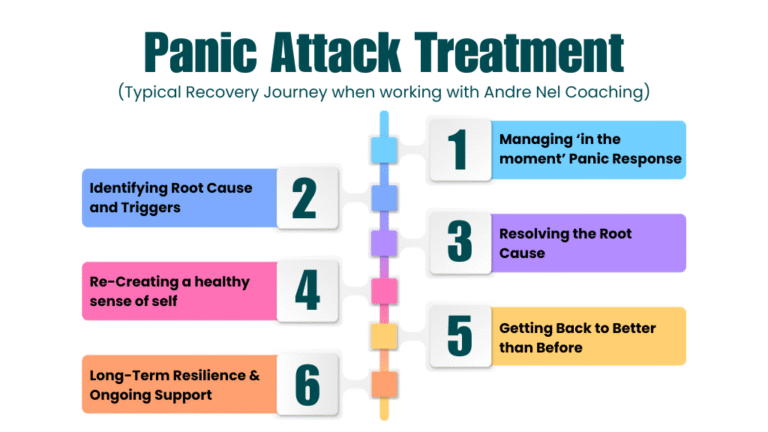
You can also learn more about the panic attack recovery journey and panic attack treatment here.
And if you’re not quite ready for that yet, start by reading this guide on how to handle panic attacks by yourself. Understanding how to handle panic attack symptoms without fighting your body is one of the most important first steps in panic attack treatment and the panic attack recovery journey.